The Six Rules of the Path: An Esoteric Interpretation
Among the many occult instructions given to aspirants within the Theosophical tradition, few passages are as psychologically penetrating and spiritually demanding as the “Six Rules of the Path” found in Glamour: A World Problem by Alice Bailey. These Rules, sometimes called the “Rules of the Road,” are not merely ethical aphorisms or mystical poetry. They are initiatory instructions given to those who seek to consciously tread the Path of Discipleship.
At first reading, the Rules may appear symbolic, obscure, or even excessively idealistic. Yet when examined in the light of earlier esoteric teachings on Chelaship, they reveal themselves to be among the most practical and uncompromising descriptions of the inner life of the disciple.
The Rules describe not merely what the aspirant must believe, but what he must become.
This distinction is of supreme importance. Furthermore, we must remember that these rules are for aspirants on the path of discipleship. These rules are fully applicable once the chela graduates from the Probationary path.

Modern spirituality often emphasizes experiences, techniques, powers, energies, or intellectual systems. The ancient schools, however, placed the primary emphasis upon character building, harmlessness, purification, and selflessness. The true disciple was recognised not by his claims, nor by his psychic experiences, but by the refinement of his nature, the steadfastness of his service, and the disappearance of selfishness from his motives.
Today, unfortunately, selfishness is celebrated as an ingredient on the path. As if one can escape samsara by being more self-seeking and ambitious.
It is for this reason that the qualifications for Chelaship given in the older esoteric traditions illuminate the “Rules of the Road” so perfectly.
H.P. Blavatsky writes:
“Perfect physical health; Absolute mental and physical purity; Unselfishness of purpose; universal charity; pity for all animate beings; Truthfulness and unswerving faith in the law of Karma… A courage undaunted in every emergency, even by peril to life… Calm indifference for, but a just appreciation of everything that constitutes the objective and transitory world…”
These qualifications are not arbitrary moral demands. They are necessities. The disciple cannot safely wield spiritual force while remaining inwardly divided, selfish, emotionally unstable, or deceptive. Spiritual force magnifies everything within the individual. It accelerates karma, intensifies friction, and reveals hidden impurities.
Torkom Saraydarian beautifully explains this occult law:
“When one increases his speed, he creates greater friction. When one increases his light, he sees the detail, causes, and effects of events and objects. When a man increases his strength, he evokes stronger opposition… Karma demands larger and quicker payments.”
This statement alone explains much of the suffering, conflict, and psychological crisis experienced by aspirants upon the Path. The spiritual journey is not designed to flatter the personality. It is designed to expose it.
Thus the First Rule declares:
“The Road is trodden in the full light of day, thrown upon the Path by Those Who know and lead. Naught can then be hidden, and at each turn, a man must face himself.”
This is one of the most terrifying and liberating truths in all occultism.
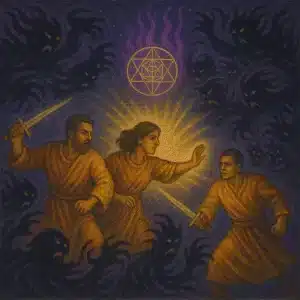
The disciple eventually loses the ability to hide from himself. Because the first step is to “KNOW THYSELF”. Motives become visible. Pretenses collapse. Self-deception becomes increasingly difficult. The individual who sincerely seeks Truth eventually discovers that the greatest battle is not against the world, but against illusion within his own nature.
“Know thyself” is a timeless philosophical Delphic maxim (Γνῶθι σεαυτόν) inscribed in the forecourt of the Temple of Apollo in ancient Greece. It refers to the Self-Knowledge which is necessary on the path to discipleship. The disciple eventually has to face himself/herself. No spiritual bypassing allowed. The disciple eventually has to fight the battle with the lower nature and come out victorious.
The Second Rule deepens this revelation:
“Upon the Road the hidden stands revealed. Each sees and knows the villainy of each. (I can find no other word, my brother, to translate the ancient word which designates the unrevealed stupidity, the vileness and crass ignorance, and the self-interest which are distinguishing characteristics of the average aspirant.) And yet there is, with that great revelation, no turning back, no spurning of each other, and no shakiness upon the Road. The Road goes forward into day.”
This statement shocks many sentimental aspirants. Yet it expresses a profound occult reality. Group work inevitably reveals glamour, ambition, jealousy, vanity, emotional instability, spiritual pride, and hidden selfishness. The closer individuals move toward spiritual light, the more forcefully the unredeemed aspects of the personality emerge into visibility.
Yet the Rule immediately adds:
“There is… no turning back, no spurning of each other…”
This is the true test of discipleship.
The immature aspirant seeks perfection in others before offering cooperation. The true disciple understands that every pilgrim is struggling upward through imperfection. Brotherhood is not founded upon ideal personalities. It is founded upon the recognition of the One Life struggling through all forms.
This is why the ancient teachings emphasized universal charity and pity for all beings. Not sentimental pity, but understanding born from spiritual perception.
The disciple on the path gradually realizes that humanity is sick with separateness. The disciple is forced to confront character defects, relationship problems, financial issues, kundalini syndromes, hidden glamours and weaknesses. All the hidden defects of one’s nature are suddenly stimulated.
But the rule is exact; there’s no turning back. Here’s why:
“On the path of discipleship there is a law to which many do not pay attention. This law states, “Whoever stops on a step of the ladder, he not only breaks the law but also violates the rights of other people to proceed.”
People enjoy life with relationships, dreams, and activities on the same level they have achieved. They read books on the same level. They meditate with the same form of meditation and on the same level of the mind, and eventually their life becomes a fenced field in which they feel happy and make their followers happy.
There is a grave danger in such a form of life. The disciple must move forward in his contacts, level, and creative service, or else he can turn and become an obstacle for himself and others. Eventually he works against those who are progressing ahead.
There are people who enter into the portion of the path for which they are ready. They work and labor for a few years and then seek shallow waters to enjoy their tired personality. They remain wise people, but spiritually they retrogress and become a bad example for others.
Once you lose the conquered territories of your spiritual striving and walk back toward your former states of consciousness, for a long time you remain sliding backward on your path. If you are lucky, life leads you into crises and painful conditions to turn you toward the future. The lost territories cannot be regained with easy effort, and often the price you pay is enormous. It is at this stage that you lose your vision.
There are also some travelers who travel on the backs of others. These are the private secretaries, co-workers, or spouses of the leaders or teachers who, because of their closeness, assume that they know everything and do not follow the disciplines. They slowly are left behind in their evolution, and when the time comes to be called for advanced promotion, they cannot meet the challenge or accept the positions, being unable to meet the responsibilities.
It is important that close co-workers of leaders spend more effort to walk on the path of spiritual discipline because they are the ones who will carry the torch of the Teaching ahead when the leader withdraws from his labor.
It is vanity to think that when you are with advanced people you are advanced and you do not need proper discipline to surpass and transcend yourself.
There are also leaders who, after a few accomplishments, sink into satisfaction and do not pursue striving and discipline.
All spiritual work requires unceasing, continuous perseverance to surpass oneself and to create larger fields of service on higher and higher planes. This is why no leader must be satisfied with his progress and achievement because he slowly prepares the seeds of destruction, apathy, and inertia.
The path is found only by a moving light. Wherever the point of light stops moving toward a future achievement, a person turns in a short while into a point of darkness.”
-Torkom Saraydarian
Leadership Vol.5
The Third Rule therefore states:
III. Upon that Road one wanders not alone. There is no rush, no hurry. And yet there is no time to lose. Each Pilgrim, knowing this, presses his footsteps forward, and finds himself surrounded by his fellowmen. Some move ahead; he follows after. Some move behind; he sets the pace. He travels not alone.
This sentence contains the very heart of the Bodhisattvic ideal.
The Path is not an escape from humanity. It is a deeper entrance into responsibility for humanity. The disciple advances together with others. Sometimes he leads; sometimes he follows; sometimes he protects weaker travelers; sometimes he himself requires guidance.
The illusion of isolated spiritual attainment slowly disappears. The purpose of spiritual development is service. Hence, any selfish isolation in the name of enlightenment is not spiritual development as taught by the Masters of the Hierarchy.
Geoffrey Hodson described this beautifully in his essay upon the “Stairway to Discipleship”:
“Each mounting and each successive ‘step’ brings its own interior reward… chiefly in terms of participating in the Master’s state of consciousness. This includes reductions—step by step—of the illusion of separateness and entry into the experience of the truth of unity.”
The destruction of separateness is the hidden purpose behind all true occult training. In spirituality, there is only oneness. The sooner we realise this the better we can navigate our spiritual progress.
This explains the warnings given in the Fourth Rule. The disciple must avoid:
“Three things the Pilgrim must avoid. The wearing of a hood, the veil which hides his face from others; the carrying of a water pot which only holds enough for his own wants; the shouldering of a staff without a crook to hold.”
The hood symbolises concealment, spiritual pretension, and false mystique. One should not wear a mask of Virtues or Character building on the path. The selfish water pot symbolises spirituality pursued merely for personal gain, power, comfort, advancement, or protection.
The Path becomes dangerous the moment spirituality is used to magnify the personality instead of transcend it. One then enters the path of Black Magic.
The fourth rule is therefore a warning against the left-hand path of black magic.
An Adept warned Geoffrey Hodson:
“Eliminate wholly and completely every trace of desire for personal gain of any kind; for this is the tragic mistake—the Judas Iscariot error.”
This warning cannot be overstated.
The greatest danger to the disciple is not failure, but spiritual selfishness disguised as devotion.
True occultism has always demanded renunciation—not necessarily outer renunciation, but the renunciation of separative self-interest.
Blavatsky expresses this uncompromisingly:
“True Occultism or Theosophy is the “Great Renunciation of SELF,” unconditionally and absolutely, in thought as in action. It is ALTRUISM, and it throws him who practises it out of calculation of the ranks of the living altogether. “Not for himself, but for the world, he lives,” as soon as he has pledged himself to the work.”
— H.P Blavatsky
Raja-Yoga or Occultism, 32
“the shouldering of a staff without a crook to hold.” is therefore the Will of the disciple only used towards selfish ends. Such a Will is a shortcut to the left-hand path.
The Will of the disciples must eventually be transformed into Goodwill or the will to do good.
This is the very foundation of the Fifth Rule, wherein the disciple carries:
“Each Pilgrim on the Road must carry with him what he needs: a pot of fire, to warm his fellowmen; a lamp, to cast its rays upon his heart and show his fellowmen the nature of his hidden life; a purse of gold, which he scatters not upon the Road but shares with others; a sealed vase, wherein he carries all his aspiration to cast before the feet of Him Who waits to greet him at the gate—a sealed vase.”
The disciple must become useful. He/she must become a divine servant.
As Mahatma Choa Kok Sui taught about the purpose of spiritual development:
“To produce intelligent, compassionate, good hearted powerful disciples… who will become great Divine Servants to accelerate the evolutionary development of the soul, so that a person may be of greater service to mankind and the Planet Earth.”Extracted from The Origin of Modern Pranic Healing & Arhatic Yoga by MCKS, 2006, page 164 & 169
So, a disciple’s presence must strengthen others. His/her speech must illumine rather than wound. His/her knowledge must nourish rather than inflate pride. Even his/her resources become instruments of service.
The “sealed vase” carried by the pilgrim symbolizes the preserved purity, virtues, moral qualities, aspiration of the soul, guarded from corruption by vanity and lower desire, to be offered eventually at the feet of the Higher Life or at the feet of the Master.
The Sixth Rule summarizes the qualities of the true disciple:
“The Pilgrim, as he walks upon the Road, must have the open ear, the giving hand, the silent tongue, the chastened heart, the golden voice, the rapid foot, and the open eye which sees the light. He knows he travels not alone.”
These are not poetic ornaments. They are occult attainments.
The “silent tongue” refers to the mastery of harmlessness and disciplined speech. The “golden voice” is speech purified of cruelty, hatred, manipulation, and vanity. The voice that nurtures others.
The “open eye” is spiritual perception or the power of intuition developed through years of meditation. The “chastened heart” is the astral body purified through suffering and experience.
The “open ear” refers to the unprejudiced way of seeing things. It is being receptive. A quality to be developed along the way.
This emphasis upon character over intellectual attainment appears repeatedly throughout the ancient teachings.
The Teachings of the Temple Vol 1 by Master Hilarion declare:
“Nowhere in literature may the true qualifications for Chelaship be found more clearly defined than in the Sermon on the Mount : The poor in Spirit ; the Sorrowing ones ; the Meek ; the Merciful ; the Peace-makers ; the Persecuted ; the Pure in heart. These are the children of God, the true disciples, the Chelas of the Masters. Without these attributes, all the knowledge in the Universe would not avail. It is what we ARE, our interior character, not what we know or believe, that constitutes the basis for Chelaship in the White Brother a hood.”
This statement strikes directly at one of the greatest modern illusions: the belief that spiritual advancement is primarily intellectual.
Knowledge alone does not produce discipleship.
One may possess vast occult information while remaining inwardly selfish, emotionally unstable, vain, cruel, ambitious, or separative. The true Path demands transformation of being itself.
It is for this reason that Master Choa Kok Sui in the Golden Lotus Sutras emphasized:
“There is a minimum standard. Disciples are supposed to possess self-control and refinement, and to be cultured.”
(Compiled by Charlotte Anderson)
The Path is not lawlessness masquerading as spirituality. Neither is it emotional indulgence disguised as mysticism. Refinement, discipline, self-control, harmlessness, and responsibility are not optional qualities to be cultivated. They are prerequisites for safely treading the path to Discipleship.
The true disciple therefore becomes increasingly characterized by simplicity, steadiness, service, harmlessness, and inner strength.
He/she gradually ceases to ask:
“What can spirituality give me?”
Instead, he/she asks:
“How may I become useful to the world?”
This marks the transition from aspirant to disciple.
The “Rules of the Road” are therefore not abstract mystical instructions. They are a map of the interior transformation through which separateness is destroyed and the consciousness of unity gradually emerges.
The Road is difficult because it strips illusion away.
The pilgrim walks among countless others upon the same ancient ascent toward Light.
And above the stairway, as Geoffrey Hodson beautifully wrote, there still stands the eternal “Caller,” summoning humanity upward toward that state wherein selfishness disappears and the One Life is known within all beings.
Let us all remember this simple formula: “IN SPIRITUALITY THERE IS ONLY ONENESS!”